
The British Electroacoustic Network (BEAN) is the national body for electroacoustic music in Britain.
The network connects electroacoustic composers, performers, and listeners from across Britain. It aims to generate and promote new electroacoustic music, disseminate electroacoustic music through concerts and events, and increase access to electroacoustic music (through the promotion of calls for works, events, and competitions) . As the national body , BEAN aims to promote British electroacoustic music overseas. It is the National Federation Member of the International Confederation of Electroacoustic Music, an NGO Partner of UNESCO and Member of International Music Council.
Places We’ve Been
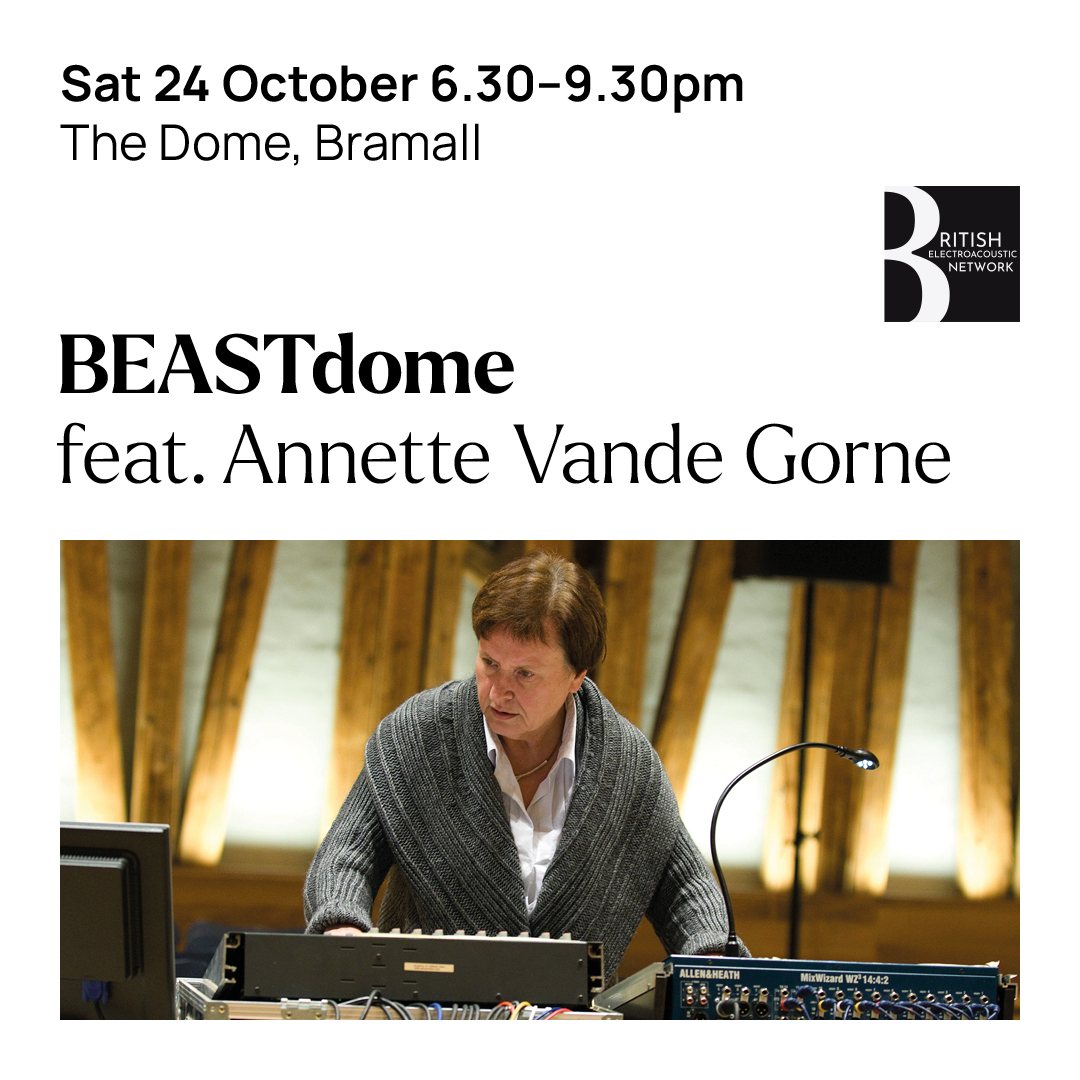
Each year we shortlist 10 works to represent BEAN in performances for the upcoming year, see where they’ve gone!



Featured Opportunity
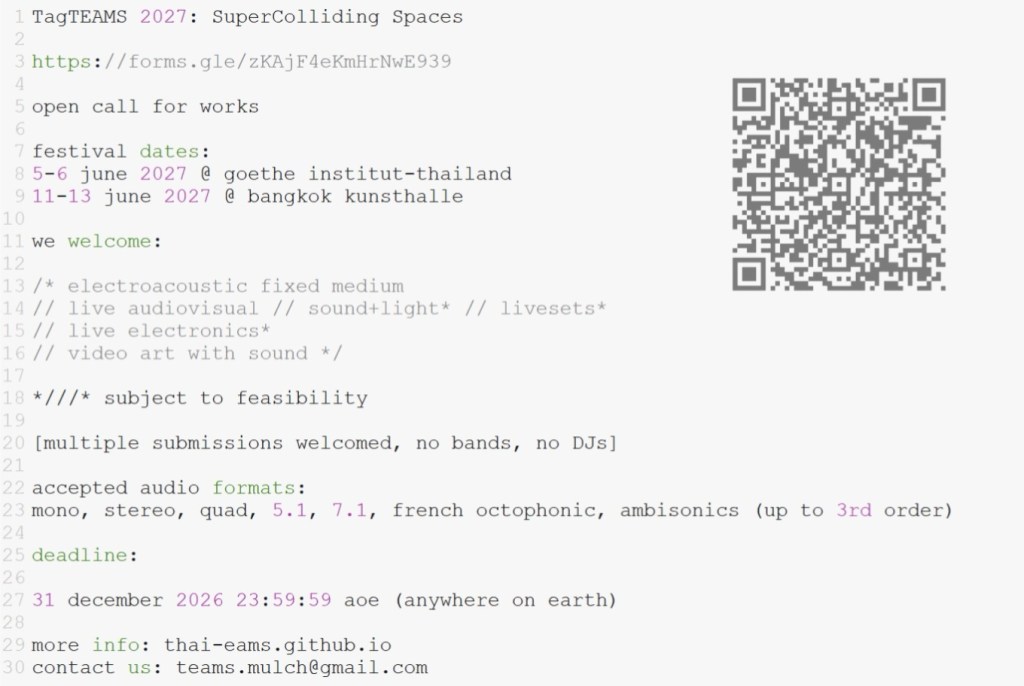
TagTEAMS 2027: “SuperColliding Spaces” Open Call for Works
Free | Bangkok, Thailand | Deadline: 31 December 2026
More info
Space has long been the primary domain of discourse in electroacoustic music, from the space the sound is being situated in, to the space that the sound is being projected at. In the context of our festival which also spans digital arts and electronic music beyond the school of the acousmatic, the meaning of ‘space’ expands instantly as those worlds collide. For our sophomore edition, TagTEAMS 2027 returns with the theme of “SuperColliding Spaces.” Here, a collision of spaces—space as interpretive, imagined, and physical; the space sound inhabits, travels through, and transforms; outer space itself; and the spaces where different artistic practices intersect, overlap, and collide—takes center stage.
The Thai ElectroAcoustic Music Society (TEAMS) is seeking submissions for TagTEAMS 2027, the second edition of TEAMS’s annual festival of electroacoustic music and digital arts in Thailand.
*Selected artists are NOT required to attend the festival in person, but encouraged.
Categories for works accepted for consideration include:
- Fixed Electroacoustic Work (fixed media, with or without video, including works in ambisonics)
- *NEW* Mixed Electroacoustic Work (works for solo live instruments and electronics)
- *NEW* Keyboard + Electronics Work (works for keyboard and electronics)
- Live Electronic Performance (live sets)
- Video Art with Sound (audiovisual works and short films included)
*Artists may submit multiple works as separate entries.*
We welcome the following audio formats:
Monaural, Stereophonic, Quadraphonic, 5.1, 7.1, Octophonic (French), and Ambisonics (up to 3rd Order)
Electroacoustic works and performances length should nominally be under 15 minutes, while short films should not exceed the length of 40 minutes while also not less than 5. Thai artists and composers are especially encouraged to submit.
Loudspeaker configuration and channel configuration are subjected to change based on technological and logistical availability without prior notice.
Please note that works submitted to the open call must be completed before submission of the call. DJs and bands will not be considered. TagTEAMS is set to be held in April 2026 at Bangkok Kunsthalle, with curated works performed on the TEAMSpace non-standard multi-loudspeaker diffusion system.
Submissions must be made to this Google Forms by 31st December 2026, 23:59:59 (AoE – Anywhere on Earth). Results will be notified privately.
For any inquiries regarding the open call application process, please contact teams.mulch@gmail.com
Upcoming Events

Sound spatialisation in composing and performing acousmatic music: the states of the art, and our current directions with the Bristol University Loudspeaker Orchestra
Free | G.16, Victoria Rooms Building, Queens Road, Bristol, BS8 1SA
12 November 2026 – 1pm
More info
Sound spatialisation has a solid history in acoustic music, from Gabrieli’s antiphonal groups calling across St Mark’s Basilica in the 16th century, to Birtwistle’s formalised processionals in the 20th; and from the stage distribution of the instruments as spatial co-rider in Webern’s Klangfarbenmelodie, to off-stage fanfares of dramatic import in opera. I’ll review snapshots of some of these scenarios and their motivations, but my main object will be to illustrate some inherent limitations. One such limitation might be that the sound of a singer or instrumentalist can’t move quickly in space without some rather comedic stagecraft. Another is that the position of a sound is tied to the sonorities of the instrument or voice needed to make it.
Acousmatic music — the extended family of sound art that uses electronic means but no acoustic performers or things to see: music for listening — offers a different prospective. The material might be anything that can be recorded or created electronically, whereas the spatial location might be that of any loudspeaker(s) that can replay the material. Early recording media had technical limits of dynamic and spectral range and a single channel of audio. Sound diffusion, emerging with the new compositional practice from the 1950s onwards, offered a means to interpret and expand the implicit spaces and unfold their figurative or abstract import in the music through real-time and dynamically changing distribution in an orchestra of loudspeakers. This performance tradition has evolved into many branches, aided by constant evolution of technologies. Its possibilities fold back deeply into philosophies, expressive languages, theories and techniques of compositional practice. The shared key, for the kinds of music I am looking at today, is that spatial concerns are fundamental and intrinsic.
There are tensions, even contradictions. A few of the polarities one could mention concern individual listening (as composer in the studio, or as audience-listener) versus sharing in concert; an ideal of spatial content for perfect reproduction versus an ideal based on liveness and interpretation for the unique moment; an orchestra of individually characterful loudspeakers versus an array of shared neutral character; bespoke systems in the research community vs commercial imperatives and standards; and the pros, cons, claims and counterclaims for the various families of technical mechanism. Taken together, these make for challenges but also lots of stimulus. I will illustrate with a few examples from my own compositions and discuss the approaches we take and our current research directions with the Bristol University Loudspeaker Orchestra, BULO.
BULO’s next concert is the day after this presentation. After today’s preview in words, please come and hear the music! More about the event here: https://www.bristol.ac.uk/arts-law-social-sciences/events/2026/november/bristol-university-loudspeaker-orchestra.html
Bristol University Loudspeaker Orchestra: Sonic Voyages: Making the Weather
£5 + VAT | Victoria Rooms Building, Queens Road, Bristol, BS8 1SA
13 November 2026 – 1.15pm
More info
Neal Farwell: Firing a Crucible (2026) †
Lia Su: After Bee (2026) †
Champion Qin: new work *
Denis Smalley: The Voices of Circius (2015-16)
Andrew Lewis: Polar (2026) †
† UK premiere
* world premiere
This year sees the 80th birthday of composer Denis Smalley. Through his music, writing and teaching, he is a defining figure for our art-form and its scholarship. To join in the international celebration, BULO presents a work in which Smalley makes the weather resound: Circius is Roman god of the Cers wind, which impetuously shapes the weather in the south west of France. In Polar, Andrew Lewis works with scientific data on the movement of sea ice, to create a powerful commentary on the ways that humans are changing our planetary climate. Our concert, presented in the glorious immersive surround sound of BULO, is rounded out by premieres of music by University of Bristol composers.
Admission: £5 + VAT (free for UoB students & staff with valid UCard).
- Please note that all attendees, including those eligible for free admission, must book a ticket online in advance via the University Online Shop.
- Tickets are available up until the start of the performance / 1.15 pm (subject to availability).
- Doors close at 1:15 pm. No latecomers admitted.
- We cannot accept cash or card payments on the door.

Changing Gear: Music from the Peak with Layla Legard, Gilank & Eleanor Hooper
£10/7 | Main Road, S32 1BB, Hathersage
22 November 2026 – 7pm
More info
From ancient paths and caves guarding mysteries to the songs of plants, three artists perform new music inspired by the land, people and stories of the Peak District.
Marking the 75th anniversary of the creation of the Peak District National Park, Layla Legard, Gilank and Eleanor Hooper each present a response to this unique landscape, weaving together electronics, haunting layered vocals, field recordings, deep listening and improvisation to transport us to worlds both on our doorstep and further than we can imagine.
Layla Legard: This Is A Portal
Half of the experimental duo Hawthonn and drummer with Welsh-language avant-goth band Tristwch y Fenywod, Leeds-based vocalist and musician Layla Legard draws inspiration from landscape and place via archaeological research, imaginative and magical practices, and improvisation.
This is a Portal developed from field recordings and improvisations at Hob Thirst’s House: a cave near Buxton where in the 1890s a Romano-British burial was discovered, with coins, jewellery and precious objects suggesting offerings at a religious site.
The piece uses treated field recordings of ancient instruments combined with impulse responses, tape loops, gong and spoken word to explore a collaboration with a presence that continues to linger in the cave.
Gilank: Cavus
Creating improvised sound worlds of hypnotic beauty and strangeness, Bradford ambient duo Gilank (Alice Gilmour and shi Blank) combine synths, electronics and effects with acoustic instruments including violin, cello, flute, percussion and vocals.
Born out of a visit to Poole’s Cavern near Buxton, Cavus seeks to capture the mystery, darkness and timeless majesty of a place shaped over thousands of years. Awed and slightly unnerved by the vastness of the space, Gilank began exploring how those emotions might become music. Acoustic and electronic instruments merge with field recordings from the visit, allowing the cave itself to become part of the composition.
Eleanor Hooper: Go Gather Bones
Eleanor Hooper is a Sheffield-based singer, composer and sound artist making lyrical, voice-centred work, rooted in deep listening and moving between song, sound art and installation.
Go Gather Bones is an evolving musical exploration of a deep connection with places in the Peak District as sonic collaborators, using field recordings, deep listening, vocal improvisation and bio-sonification of plants in these locations. The music comes out of Wet Withens Stone Circle and Barrow, the Seven Stones of Hordron, and the ancient drovers’ path and woods in and around Lawrence Field.
The three performances have been commissioned as part of Changing Gear, our programme supporting women and gender-diverse musicians to create new electronic music.
YSWN is a PRS Foundation Talent Development Network Partner supported by PPL.
Become a Member
BEAN membership is free to join for UK* and international members. The registration is linked below, and doing so only takes a minute. By signing up you will receive monthly digests of opportunities and events around the country, as well as being able to submit your own events and calls across the network!
*UK members include anybody currently living/working/studying in the UK, or British Citizens working abroad.
Please note that opportunities and events submitted by international members are considered for publication based on their relevance and accessibility to UK members.
Donate to BEAN
While membership remains 100% free, donations are greatly appreciated. The money received goes towards running costs for this website, and the annual CIME membership fees. Any donations received beyond this amount will be put solely toward the upkeep and expansion of the platform.
©British Electroacoustic Network 2026